
Cardio & VO2 Max
How to Test VO2 Max
Breath-gas testing directly measures oxygen uptake for about $150–$315 at two US labs. Field tests and watches estimate it with more uncertainty.
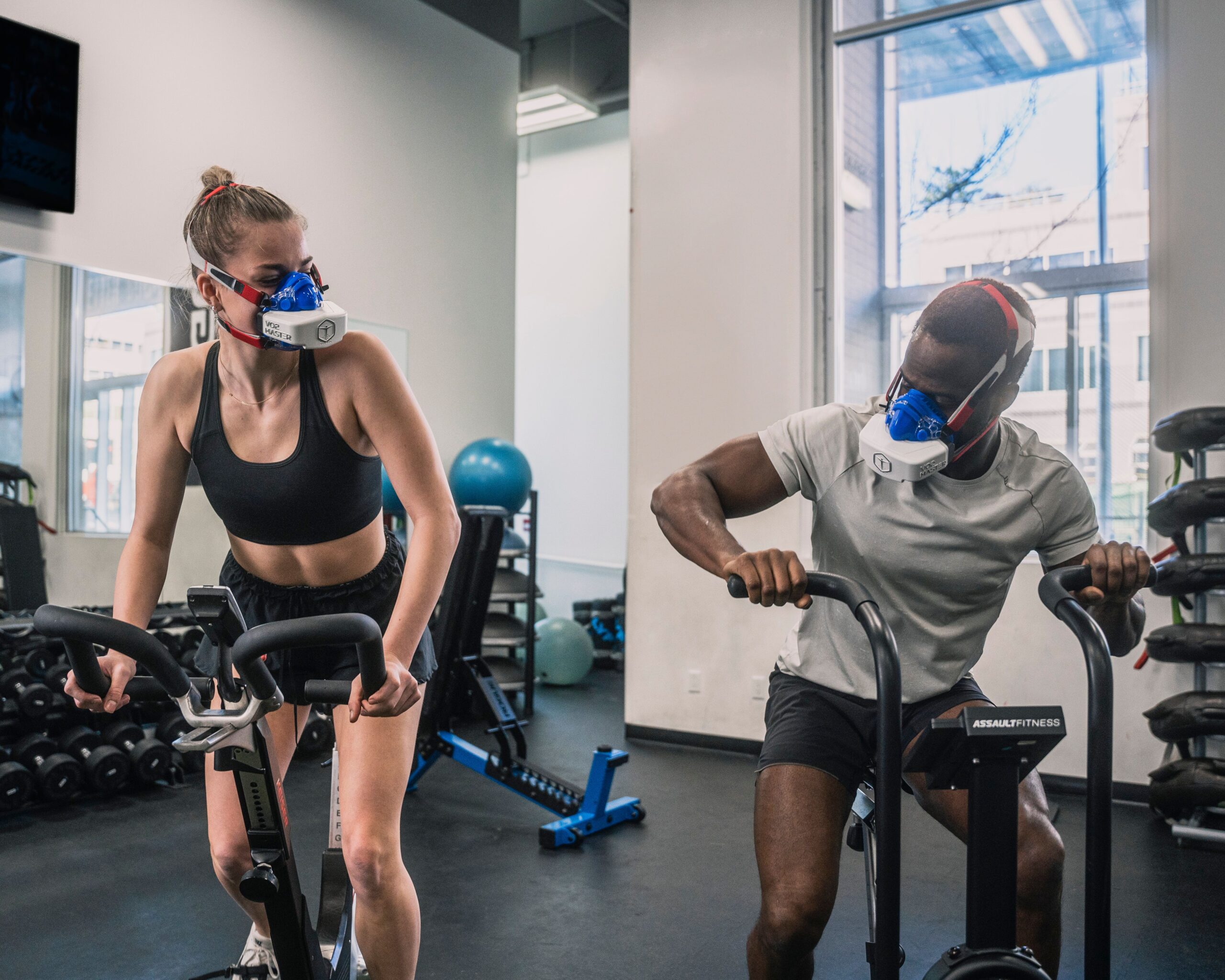
VO2 max is the highest rate of oxygen use reached during intense exercise. Cardiorespiratory fitness—how well the heart, lungs and muscles supply and use oxygen during exercise—is associated with the risk of death in studies that follow people over time, which is why people interested in living longer and better may want to measure it. Humanic Blue starts with the question your watch may have raised already: can you trust that number?
Here’s how to test VO2 max. The direct method is a treadmill or bike test that gets progressively harder while equipment measures oxygen use from the breath. If oxygen use levels off even as exercise gets harder, that supports a true maximum, or VO2 max. Many people stop first, so laboratories may report VO2peak: the highest value reached in that test. Two US performance labs listed $150 and $315 when checked in September 2026. Clinical cardiopulmonary exercise testing, or CPET, adds medical interpretation for symptoms or disease. Without a lab, the 12-minute Cooper run, one-mile Rockport walk, questionnaire models and watches estimate fitness from equations. They do not measure oxygen uptake.
Below, we cover each route: what happens, what it costs and when it makes sense.
Key Takeaways
- Breath-gas analysis directly measures oxygen uptake; whether the highest value qualifies as VO2 max or VO2peak depends on the protocol, effort and response.
- Field tests such as the Rockport 1-mile walk tracked lab-measured VO2 max closely across the people in their original studies, but individual estimates can still miss.
- The number predicts risk at the population level; no study has shown that testing it helps people live longer. Evidence that fitness predicts risk does not show that testing improves health.
Route 1: How does the lab test with a mask work?
This is the reference method. You exercise on a treadmill or stationary bike while intensity rises in stages. A mask or mouthpiece routes each breath through gas-analysis equipment, sometimes called a metabolic cart, which measures oxygen consumption and carbon-dioxide production. A performance test usually continues to voluntary exhaustion; a clinical test may stop earlier for symptoms or safety criteria.
The number you get is in milliliters of oxygen per kilogram of body weight per minute (mL/kg/min). Some labs add related measures. The Hospital for Special Surgery (HSS), for example, lists lactate threshold—the exercise intensity around which blood lactate starts to rise—and running or cycling economy, meaning oxygen used at a given pace or workload.
Two places that publish their prices show the range—not a national market average. Marquette University’s Human Performance Assessment Core lists a one-hour VO2 max test for $150, or $175 with blood lactate. The Hospital for Special Surgery’s performance center in New York lists an aerobic-capacity test for $315 in its 2026 pricing. Both pages were checked September 29, 2026.
Where to look: university exercise-science or kinesiology departments, hospital sports-medicine or performance centers, and some fitness facilities with a metabolic cart. Search for “VO2 max test” plus “human performance lab” and your city.
The catch: the highest measured value depends on protocol, exercise mode, effort and why the test stops. As an American Heart Association CPET commentary explains, many sedentary adults and cardiac patients stop before showing the oxygen-uptake plateau used to establish a physiological maximum; VO2peak is then the more accurate term.
Route 2: The clinical CPET
A cardiopulmonary exercise test uses the same breath analysis, but a clinician orders it for a medical question. Examples include unexplained breathlessness, working out whether the heart or lungs are limiting exercise, or planning cardiac rehabilitation.
The American Heart Association describes CPET as a test that stops at symptoms or peak effort while measuring oxygen consumption, carbon-dioxide output and breathing volume. Its 2016 focused update notes that estimating oxygen uptake from workload alone can be inaccurate; breath-gas analysis measures the response instead.
Where to look: your primary care clinician or cardiologist. CPET is typically done in cardiology or pulmonary departments with medical supervision.
The catch: clinical CPET and performance testing answer different questions. Curiosity about a fitness number does not establish a medical need for CPET or suitability for a maximal performance test.
Route 3: What can a field test tell you?
Field tests estimate VO2 max from how far or how fast you move. They’re free and repeatable. Each one depends on an equation built from a specific group of people.
The Cooper 12-minute test. Kenneth Cooper’s 1968 JAMA study compared 12-minute distance with treadmill-measured VO2 max in about 100 US Air Force men aged 17 to 52. People who covered more distance generally had higher measured VO2 max, but that relationship does not guarantee an accurate individual estimate. That narrow original population matters. Cooper’s study protocol required participants to cover as much distance as possible in 12 minutes on a flat, measured course. That was a maximal exercise protocol in a military sample, not a general home-testing recommendation. A commonly used equation derived from the original relationship is:
VO2 max (mL/kg/min) = (distance in meters − 504.9) ÷ 44.73
Covering 2,400 meters, for example, gives an estimate of about 42.4 mL/kg/min.
The Rockport 1-mile walk test. This was built as a walking alternative below maximal effort. In the original 1987 study, about 350 healthy adults aged 30 to 69 completed at least two fast one-mile walks, and the predictors were compared with treadmill VO2 max. The equation tracked measured values closely in both the group used to build it and a separate group used to check it. That group-level relationship does not show how far one person’s estimate could be from their measured result.
The study’s relative-VO2 equation, reproduced in later research, is:
VO2 max (mL/kg/min) = 132.853 − 0.0769 × weight − 0.3877 × age + 6.315 × sex − 3.2649 × time − 0.1565 × heart rate
Weight is in pounds, the original binary sex code is 1 for male and 0 for female, time is in minutes with seconds converted to a decimal, and heart rate is the final-quarter/end-of-walk value in beats per minute. The original model’s typical prediction error was about 5.0 mL/kg/min, so the decimal-heavy formula should not be mistaken for decimal-level precision.
The no-exercise estimate. The Cardiac Exercise Research Group at the Norwegian University of Science and Technology (NTNU) offers a free Fitness Calculator. Its model uses sex, age, waist circumference or body mass index (BMI, weight in relation to height), resting heart rate and reported activity. It was developed from several thousand Norwegian HUNT participants who underwent treadmill testing. This is a questionnaire-based population estimate, not a personal oxygen measurement.
The catch for all three: an equation built on one population can miss for an individual, especially someone outside the ages or fitness levels it was built on. The Rockport equation uses heart rate, so medications that lower heart rate can affect it. Pacing, heat, wind and terrain move the result too.
How does the group behind a field-test equation limit where its estimate applies?
Route 4: The watch on your wrist
Consumer devices infer VO2 max from sensor and activity data. They do not measure respiratory gases.
Published device validations can produce an acceptable-looking group average while leaving wide limits for an individual. For example, a 2025 Apple Watch study analyzed about 30 adults and found a 6.07 mL/kg/min average underestimate, with a wide range of differences between individual watch and lab results; a 2026 Garmin study included about 35 young endurance athletes and found underestimation that was larger in the highly trained subgroup. These small, device-specific samples do not justify one universal watch error. More detail is in Can Wearables Estimate Biological Age?.
The catch: a watch estimate is best used as a trend under similar conditions. A software update, a switch from running to cycling or a loose strap can shift it.
What would show whether a watch estimate is accurate for an individual rather than on average?
Side by side
| Route | What it measures | Typical cost | Study or service context | Main limitation |
|---|---|---|---|---|
| Performance-lab test | Oxygen uptake directly | $150–$315 at the two labs above | A measured baseline; some labs add thresholds | Peak may not meet VO2-max criteria |
| Clinical CPET | Oxygen uptake plus heart and lung data | Varies; clinician-ordered | Medical questions about exercise limits | Not a fitness service |
| Cooper 12-minute test | Distance → estimate | Free | Original study: Air Force men aged 17–52 | Maximal effort; equation-based |
| Rockport 1-mile walk | Time + heart rate → estimate | Free | Original study: healthy adults aged 30–69 | Needs accurate heart rate and a measured mile; not automatically suitable for every walker |
| NTNU calculator | Questionnaire → estimate | Free | Model developed in Norwegian adults | Population estimate, not direct oxygen measurement |
| Smartwatch | Sensor + activity data → estimate | Device cost | Tracking a device-specific trend | Small validations report wide, device-specific error |
Should you check with a clinician before a hard test?
It depends on your current activity, symptoms or known disease, and the intensity of the test. A maximal test, whether in a lab or on a track, asks your heart to work at its limit. The American College of Sports Medicine’s preparticipation screening model weighs those three factors. The roundtable noted that warning symptoms often precede exercise-related cardiovascular events.
In the ACSM model, symptoms or known heart, metabolic or kidney disease, together with current activity and intended intensity, affect whether medical clearance is needed before exercise. These are reasons to discuss maximal testing with a clinician, particularly after inactivity. Symptoms include chest discomfort, unusual breathlessness, dizziness or fainting with exertion, or palpitations. The existing VO2 max and longevity article covers the red flags that call for medical assessment rather than a self-test.
What’s Interesting
The equations behind the free tests are decades old: Cooper’s dates to 1968 and the Rockport walk to 1987. Their many decimal places can look more exact than the underlying prediction. A smartwatch is also producing an estimate, but its full commercial algorithm is generally not available for independent inspection.
What This Means in Practice
- What question would testing answer? A lab test measures oxygen uptake and may provide threshold or training-zone data. Field and watch estimates can track a repeated protocol, but measurement error can obscure small changes. None of these results tells one person how long they will live.
- Are repeated readings comparable? Changes in course, weather, time of day or device can change an estimate independently of fitness.
- Does the original study apply? The Rockport and Cooper equations came from different populations and efforts; neither study establishes suitability for every reader.
- What does screening need to consider? The ACSM model weighs activity, symptoms or known disease, and intended intensity. A clinician can assess how these factors affect an individual’s testing options.
For a measured test, a university exercise-science lab or a hospital sports-medicine center is the usual starting point. For symptoms during exercise, see a primary care clinician or cardiologist, who may order a clinical CPET. Once you have a number, VO2 Max and Longevity explains what the research can and can’t say about it.
Bottom Line
Breath-gas testing directly measures oxygen uptake; the result may appropriately be called VO2peak if a true maximum is not demonstrated. The two US performance labs checked charged $150 and $315. The Cooper run, Rockport walk, NTNU calculator and consumer devices produce estimates whose accuracy depends on population, protocol and device. Cardiorespiratory fitness tracks with risk in observational studies, but no trial shows that testing it adds years. The ACSM screening framework considers symptoms, disease, activity and intended intensity; a test’s availability does not establish that it is safe for everyone.
A NOTE FROM LONGEVITY365
We read research, consult expert perspectives and work to make complicated health information easier to understand. What you’re reading here reflects how we’ve interpreted and organized that information. It is educational content—not personal medical advice, diagnosis or treatment guidance.
We’re not perfect, and neither is the available research. Evidence changes, new studies emerge and what’s appropriate for one person may not be appropriate for another.
Use this article as a starting point for your own research and conversations with qualified professionals. Always talk with your doctor or another trusted healthcare professional before making decisions that could affect your health, particularly if you take medications, are receiving treatment, have existing health conditions, are pregnant or have other circumstances that could affect what’s appropriate for you.
Reader Questions
A few questions to carry into the comments or your next conversation. Please leave out identifying or personal medical details.
- 01After reading this, what would you want a test result to actually help you decide?
- 02How does the distinction between measuring oxygen use directly and estimating it from an equation change what you would expect from a test result?
- 03What would you ask a clinician, lab, or qualified professional before letting a number change a health decision?
Extra Insights & Sources
The evidence summaries and linked sources behind this article.
What We Know
- Direct oxygen-uptake measurement requires breath-gas analysis during a graded exercise test; VO2peak and VO2 max are not always interchangeable. Established.
- Field tests estimate VO2 max from performance using population equations. The Rockport walk test correlated at r = 0.93 with measured values in its development sample. Supported.
- Low cardiorespiratory fitness is associated with higher cardiovascular and all-cause mortality. A 2016 American Heart Association statement judged it potentially more predictive of mortality than several established risk factors, based primarily on observational evidence. Supported association; not proof of causation.
What We Don’t Know
- Whether knowing your VO2 max, by itself, changes behavior or outcomes. No trial has tested testing. Unknown.
- How accurate each field equation is for adults over 70 or people on beta-blockers, groups the original studies didn’t center. Uncertain.
- How consumer-watch algorithms will change with future software, since they’re proprietary.
Sources
- Marquette University Human Performance Assessment Core: current public price list, checked September 29, 2026; a one-hour VO2 max test is $150 or $175 with lactate. This is one Milwaukee laboratory, not a national price estimate. https://www.marquette.edu/human-performance-assessment-core/services.php
- Hospital for Special Surgery Performance and Wellness: 2026 public price list, checked September 29, 2026; its New York aerobic-capacity test is $315. This is a performance service for people already exercising, not a clinical CPET price. https://www.hss.edu/departments/performance-and-wellness/metabolic-testing
- American Heart Association CPET commentary (2016; page updated 2020): distinguishes directly measured VO2peak from a physiological VO2 max, explains that many sedentary adults and cardiac patients stop before demonstrating a plateau, and describes CPET’s gas-exchange measures and clinical uses. https://professional.heart.org/en/science-news/2016-focused-update-clinical-recommendations-for-cardiopulmonary-exercise-testing-data-assessment/Commentary
- Cooper, JAMA (1968): compared 12-minute distance with treadmill VO2 max in 115 US Air Force men aged 17–52; correlation was 0.897. The all-male military sample limits how confidently the equation can be applied to other people. Correlation describes how closely two measures rise and fall together across a group; it does not measure the size of an individual prediction error. https://pubmed.ncbi.nlm.nih.gov/5694044/
- Kline et al., Medicine & Science in Sports & Exercise (1987): Rockport development and cross-validation study in 343 healthy adults aged 30–69; the development and validation correlations were 0.93 and 0.92, while the relative-VO2 equation’s standard error was about 5.0 mL/kg/min. https://pubmed.ncbi.nlm.nih.gov/3600239/
- NTNU Cardiac Exercise Research Group Fitness Calculator: institutional description of a non-exercise model using sex, age, body composition, resting heart rate and reported activity, developed from Norwegian HUNT treadmill data. The result is an estimate, and the page itself notes population-specific limitations. https://www.ntnu.edu/cerg/vo2max
- Lambe et al., PLOS One (2025): device-validation study with 28 analyzed adults; Apple Watch Series 9/Ultra 2 underestimated lab VO2peak by 6.07 mL/kg/min on average and had wide individual limits. Small, young sample and device-specific result. https://journals.plos.org/plosone/article?id=10.1371/journal.pone.0323741
- Engel et al., European Journal of Applied Physiology (2026): validation in 35 young endurance athletes; Garmin Forerunner 245 estimates were lower than laboratory values, especially among the highly trained. This does not establish accuracy in older or clinical populations. https://pmc.ncbi.nlm.nih.gov/articles/PMC12881131/
- Riebe et al., ACSM roundtable consensus (2015): preparticipation screening model based on current activity, symptoms or known cardiovascular, metabolic or kidney disease, and intended intensity. It is a screening framework, not a guarantee of test safety. https://pubmed.ncbi.nlm.nih.gov/26473759/
- Ross et al., American Heart Association scientific statement (2016): reviews cardiorespiratory fitness as a clinical vital sign and its observational association with cardiovascular and all-cause mortality. It does not show that testing itself improves outcomes. https://pubmed.ncbi.nlm.nih.gov/27881567/
Related product and service comparisons
The companion comparison distinguishes named mask-based testing services from watch estimates and explains their access arrangements.
Leave a Reply